Monday, March 9, 2026


Freshly Picked: The Timeless Allure of Jeannette’s "Baltimore Pear"

There is a specific kind of magic in finding a complete set of vintage glass that has survived the decades without a single flea bite or chip. This week, we’re shining a spotlight on a true American classic we just added to the shop: a Jeannette Glass Baltimore Pear Creamer and Covered Sugar Set.

If you’ve been following our journey at Bondgard, you know we have a soft spot for items that carry a story. The "Baltimore Pear" pattern is a bit of a legend in the world of pressed glass. While the design actually dates back to the Victorian era, the Jeannette Glass Company revived it in the mid-1950s, bringing that heavy, high-relief fruit pattern into mid-century homes.

Why we love this set:

  • The Detail: Look at the "finial" (the handle on the lid). That kind of craftsmanship is exactly what we mean when we say "they don't make 'em like they used to."

  • The Weight: This isn't flimsy glass. It’s substantial, crystal-clear, and has that satisfying "thunk" when you set it down on a wooden table.

  • The Versatility: While it’s technically for cream and sugar, these pieces are Art Deco enough to look stunning on a modern bar cart or even a vanity holding jewelry and cotton rounds.

As we wish for Spring here in Galesburg, we’re looking for pieces that feel "Freshly Picked." This set, with its lush vines and clusters of pears, fits that vibe perfectly. It’s a piece of 1950s Americana that is ready to write its next chapter in a new home.

Check out the full listing here and bring a little bit of history to your morning coffee.


Thursday, March 5, 2026

 The Relics and the Refresh: A Lesson in Value

I was reading a beautiful post today from a friend over at Cupola Ridge. She talked about a weather-worn relic she found in a field—something most folks passed by—and how it eventually found a sacred new purpose in her home. It got me thinking about the things we overlook, and the things we think are broken beyond repair.
In my work with Bondgard, I’m constantly drawn to the small and the fragile. I’ll find a lone demitasse teacup tucked away on a dusty back shelf of a junk store. It’s lost its set, its saucer is gone, and most people wouldn't give it a second look. But I see the square joints of its history, the "carved pockets" of its design, and I have to save it.
I think I’m drawn to them because I know what it feels like to be "weathered."
There were moments over these last few years—through the liver failure, the cancer, and even a heart attack just a week after my transplant—where I felt like that forgotten item in a field. I felt stripped of my purpose, unsure of where I belonged now that my body had changed so much.
But as the scripture says in Isaiah, "See, I am doing a new thing."
God has a way of taking what we think is a "disruption" and turning it into a "fresh assignment." I may not be the same man I was before the transplant, but I have been repurposed. My value wasn't lost in the hospital hallways; it was being transformed into something I never expected.
Now, when I’m out scouting with Rod, I don't just see "inventory." I see reminders that losing your original purpose doesn't mean you've lost your worth. Whether it's a fragile cup or a survivor like me, there is beauty in the new life that springs up after the storm.


Monday, March 2, 2026

MCM Peacock Blue Cylinder Vase

 A Splash of Mid-Century Elegance

There is something undeniably magnetic about Peacock Blue glass. It captures the light in a way that feels both architectural and organic. This 10.5-inch cylinder vase is a prime example of the bold experimentation seen in the late 20th century (circa 1970–1999).

Standing on a graceful pedestal base, the vase features a distinctive rigaree band—a decorative ribbon of glass applied to the body while still molten and then crimped into a textured, wavy pattern.

Murano or Empoli: The Italian Connection

While this specific piece is unbranded, its craftsmanship points toward the legendary glassmaking traditions of Italy. Collectors often find themselves debating between two famous origins for pieces of this style:

  • Murano: Known for high-art techniques and intricate hand-blown details.

  • Empoli: Famous for producing "Verde" and "Peacock" blue glassware that was exported globally during the MCM boom.

Regardless of its specific pedigree, the combination of the sleek cylinder silhouette and the ornate rigaree band makes it a "best of both worlds" piece—merging minimalist form with maximalist texture.

Styling the Cylinder Vase

Because of its 10.5-inch height and narrow 4 3/8-inch diameter, this MCM Peacock Blue Vase is incredibly versatile:

  1. Single Stem Statement: Use a single Monstera leaf or a tall Calla Lily to emphasize the vertical lines.

  2. Sunlight Showcase: Place it on a windowsill or a glass coffee table where the light can pass through the peacock blue glass to cast colorful shadows.

  3. The Grouping: Pair it with shorter, amber-colored glass or clear crystal to create a tiered, colorful display on a mantel or sideboard.


Product Specifications

FeatureDetail
MaterialHand-blown Glass
Height10.5"
ColorPeacock Blue
StyleModern / MCM
FeatureClear Pedestal Base & Rigaree Band


Friday, February 27, 2026

Nettie Rosenstein Vintage Spotlight: The Copper Pink Lily Pad

 Nettie Rosenstein remains a giant of American mid-century design. While she is legendary for the "Little Black Dress," her jewelry line—often produced by Sandor Goldberger—is where her whimsical side truly shines.

Today, I’m highlighting an exceptional example of her iconic Lily Pad motif: a pair of rare Nettie Rosenstein Copper Pink Jewel Earrings from the 1940s.

Why This Pair Stands Out What makes these earrings special is the uncommon color palette. While Rosenstein often utilized gold-tones, the warm copper finish on these lily pads provides a stunning, earthy backdrop for the vibrant pink jewel accents.

The "lily pad" texture is incredibly detailed—a hallmark of the high-quality craftsmanship associated with the Rosenstein name. These are quintessential 1940s "statement" clips that manage to feel both organic and glamorous.

Collector's Tip When sourcing Nettie Rosenstein, look for the signature "Nettie Rosenstein" or "Rosenstein" stamp. Her pieces are known for heavy plating that resists wear, making them excellent investment pieces for any vintage jewelry collection.


Nettie Rosenstein

Saturday, February 21, 2026


A Piece of Chicago’s "Golden Age": The Maxim’s de Paris Ashtray

In the world of vintage collecting, there are items that are beautiful, and then there are items that carry an entire era with them. This 4 1/2" square porcelain ashtray is definitely the latter.

A Little Taste of Paris in the Gold Coast

If you lived in Chicago in the 1960s or 70s, Maxim’s de Paris wasn't just a restaurant—it was the destination. Tucked away in the basement of the iconic, Bertrand Goldberg-designed Astor Tower, Maxim’s was a lush, red-velvet-lined replica of the original Art Nouveau institution in Paris.

It was opened in 1963 by Nancy Goldberg (the architect’s wife and a legendary socialite in her own right), and it quickly became the city’s first 5-star restaurant.

The "Chasseur" and the Celebrities

This ashtray features the iconic Maxim’s "Chasseur"—the bellhop in the bright red uniform who became the face of the brand. When you look at this piece, you aren't just looking at a souvenir; you’re looking at something that likely sat on a table while the likes of Frank Sinatra, Audrey Hepburn, or The Beatles dined nearby. (In fact, the Beatles held their famous 1966 "we're more popular than Jesus" apology press conference right there in the building!)

Why It’s a Collector’s Gem

While you can find Maxim's memorabilia from the Paris location, pieces specifically branded "Chicago" are much harder to come by.

  • The Design: High-gloss white porcelain with a Mid-Century square profile.

  • The History: It represents a time when the Gold Coast was the center of the culinary world.

  • The Condition: This estate find has been remarkably preserved, with the red and yellow graphics still as vivid as they were fifty years ago.

This piece is currently available in our eBay shop.


Friday, February 20, 2026

The Heart of the Matter: A 1940s Coro Rediscovery

There is a specific kind of joy in looking at a piece of jewelry you thought you knew, only to see it in a completely different light.

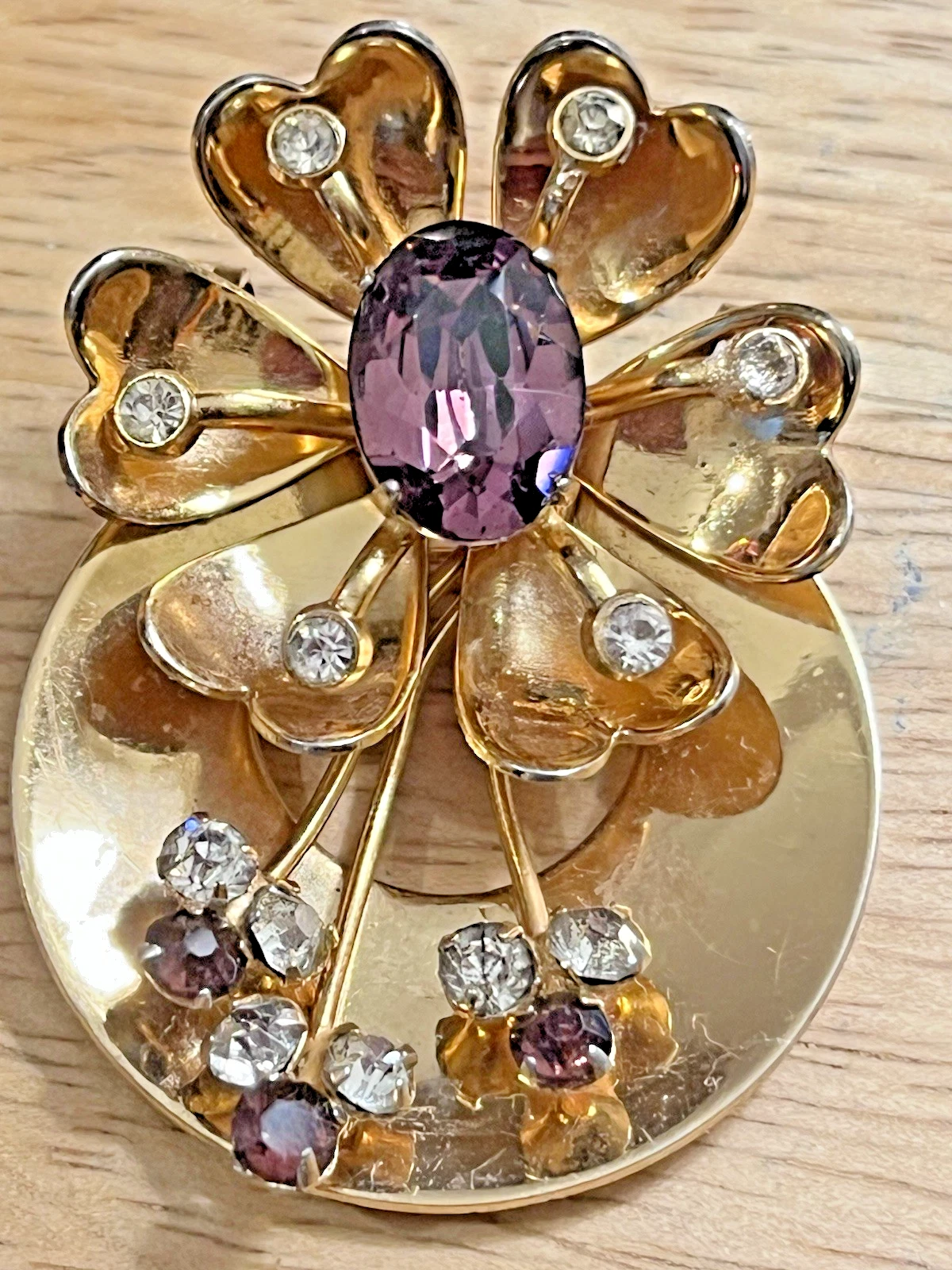
This signed Coro brooch from the 1940s Retro era is exactly that for us. We’ve had it in the vault for a while, but pulling it out today felt like seeing it for the first time. The way the deep Amethyst purple glass center plays against the gold-tone hearts is nothing short of regal.

Why Coro Matters

In the 1940s, Coro was the powerhouse of American costume jewelry. They were masters of the "Retro" style—bold, sculptural, and unashamedly romantic. This piece is a perfect example: five polished hearts forming a flower, set against a circular "halo" base. It’s architectural yet soft.

The "New" View

Maybe it’s the way the light hit it today, or maybe it’s just that we’re finally seeing clearly, but this purple is spectacular. It’s a reminder that vintage pieces aren't just objects; they are moods. This brooch is a "good day" mood.

The Bondgard Touch: Whether you pin it to a velvet blazer or a simple white tee, this is a piece that demands a second look. As always, it will arrive at your door with our signature "class act" packing.

Collector's Tip: Check your package for the Bondgard card! 


The "Style Hack": One Piece, Three Ways

Since this Coro treasure features that hidden pendant loop, it’s basically the "Swiss Army Knife" of your jewelry box. Here’s how we’d style it:

  • The Modern Choker: Slide a 1" black velvet ribbon through the pendant loop. Tie it closely around the neck for a look that is pure 1940s-meets-Gothic-Romance. The weight of the amethyst glass sits perfectly against the velvet.

  • The "Power Lapel": Pin it traditionally to a sharp, oversized blazer. Because of the gold-tone "halo" design, it holds its own against heavy fabrics like wool or tweed without getting lost.

  • The Silk Scarf Slide: Instead of pinning through your favorite silk scarf (and risking a snag!), loop a thin chain through the pendant bail and use the brooch as a "weight" to keep your scarf draped perfectly in place.

 Click to View or Purchase

Thursday, February 19, 2026

Urban Armor: The Wild Precision of Ted Rossi

At Bondgard Dekor & Art, we don't just look for "vintage"—we look for pieces that have a soul and a bit of a bite. That’s exactly what drew us to this early 2000s era 70s style Ted Rossi NYC cuff. From Engineering to the Runway There is a reason this bracelet feels so substantial. Ted Rossi actually started his career as an engineer before he decided to "smash the boring language of fashion." You can see that technical precision in the way this piece is constructed, but he wrapped it in something much more primal: metallic snakeskin and gold. The "Talon" Clasp The standout feature of this cuff is the sculptural gold Talon. In the 2000s, this was "Urban Armor." It was designed for the woman who wanted to walk into a room and feel untouchable. It’s a mix of Halston-style glamour and a fierce, avant-garde edge that still feels incredibly modern today. Why We Curated It We love the "Small Wrist Struggle" (it’s 6.5" of pure style!). It’s a petite piece that packs a massive punch. Whether you’re a collector of NYC fashion history or just someone who appreciates the feel of genuine exotic skins, this cuff is a masterpiece. The Bondgard Touch: As always, this piece will be packed with the "class act" care we’re known for. And don’t forget—check your package for the Bondgard card. That 15% discount code is yours to use forever and always on all your future treasures! View or Purchase - Here